


Cross-Linking Is Important, but It’s Not the Whole Story
If you’ve been diagnosed with keratoconus, there’s a good chance you’ve heard something like this:
“You need cross-linking to stop progression.”
And that’s true. Corneal cross-linking is one of the most important advancements in modern keratoconus care. It’s often the first step in protecting your vision long-term.
But it’s not the whole story.
Cross-linking is designed to stabilize the cornea. What it doesn’t do is fully restore the quality of your vision. That’s where many patients feel stuck…grateful the condition isn’t getting worse, but still struggling to see clearly.
The reality is this: stability is step one. Vision improvement is step two.
And today, there are more options than ever to help you get there.
What Cross-Linking Actually Does
Corneal cross-linking is a minimally invasive treatment that strengthens the cornea by increasing the bonds between collagen fibers.
In keratoconus, the cornea becomes weak and begins to bulge outward into a cone-like shape. Cross-linking works to reinforce the structure of the cornea, helping to stop or slow that progression.
This is critical. Without stabilization, vision can continue to decline over time. But here’s an important clarification that often gets overlooked:
Cross-linking is not designed to significantly improve vision on its own.
Some patients notice small improvements, but the primary goal is to preserve the vision you have, not to fully correct it.
The Missing Piece: Corneal Shape Still Matters
Even after successful cross-linking, the cornea may remain irregular.
That irregular shape is what causes distorted, blurry, or fluctuating vision in keratoconus. So while the condition may no longer be progressing, the visual challenges don’t automatically go away.
Many patients still rely on:
- Glasses, which may only provide limited improvement
- Specialty contact lenses, such as scleral lenses
- Ongoing adjustments to manage changing vision
This can be frustrating, especially if you were hoping cross-linking would be the complete solution. The truth is, stabilizing the cornea doesn’t necessarily normalize it.
A More Complete Approach: Stabilize + Reshape + Optimize Vision
At leading centers like our very own Cornea and Laser Eye Institute, keratoconus treatment is approached more comprehensively.
Think of it as a three-step process:
- Stabilize the cornea (typically with cross-linking)
- Improve the shape of the cornea
- Optimize vision based on that new shape
This “stabilize + reshape + optimize” approach (we call it KC 1, 2, 3 here at CLEI) reflects how keratoconus is actually experienced by patients, not just as a disease to stop, but as a vision problem to improve.
Advanced Options to Improve Corneal Shape
Once the cornea is stable (or in some cases, treated simultaneously), several advanced procedures can help improve its shape and, in turn, visual quality.
1. Laser-Guided Cross-Linking
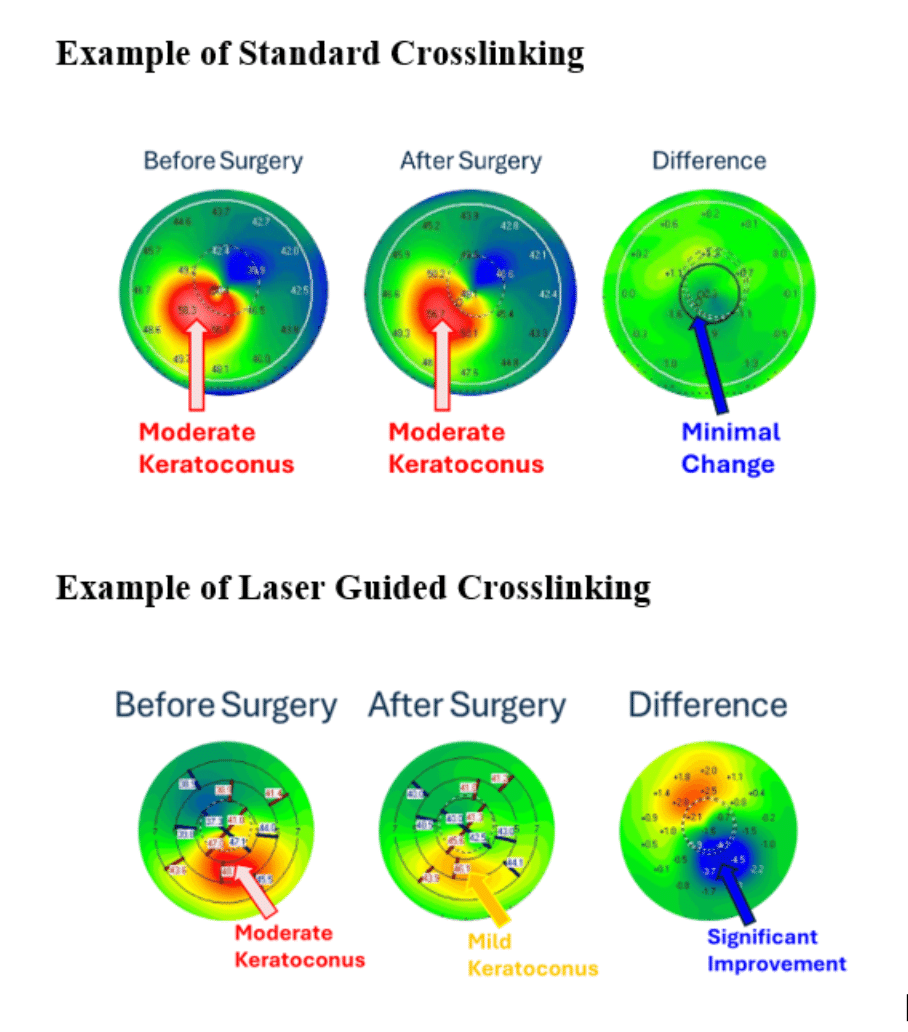
Laser-guided cross-linking is an emerging advancement that builds on traditional cross-linking.
Instead of applying treatment uniformly across the cornea, this approach uses detailed imaging to guide where the treatment is delivered.
What makes it different:
- It targets the weakest or most affected areas of the cornea
- Treatment can be customized based on the patient’s specific corneal shape
- It has the potential to both stabilize and partially regularize the cornea
While still evolving, this more tailored approach reflects a broader shift in keratoconus care, moving from one-size-fits-all treatments to personalized, data-driven solutions.
2. CTAK (Corneal Tissue Addition Keratoplasty)
Corneal Tissue Addition Keratoplasty is a newer surgical technique designed to reshape the cornea by adding tissue rather than removing it.
In keratoconus, the cornea becomes uneven and asymmetrical. CTAK works by strategically placing donor corneal tissue to improve that shape.
Key benefits:
- Improves corneal symmetry
- Reduces irregular astigmatism
- Preserves corneal thickness (a major advantage for many patients)
This can be especially helpful for patients with moderate keratoconus who may not be ideal candidates for laser-based procedures.
Notably, CTAK was developed and refined through clinical research at CLEI, positioning the institute at the forefront of innovation in keratoconus treatment.
3. Topography-Guided PRK
Photorefractive Keratectomy, specifically topography-guided PRK, is a highly customized laser procedure that reshapes the surface of the cornea.
Using detailed corneal mapping, the laser smooths out irregularities to create a more uniform surface.
What sets it apart:
- Treatment is guided by the unique topography of your eye
- Focuses on improving visual quality, not just prescription
- Can significantly reduce distortion and improve clarity
In some cases, topography-guided PRK is combined with cross-linking, either at the same time or in stages, to both stabilize and reshape the cornea.
Why Combination Treatment Matters
No single procedure can address every aspect of keratoconus.
That’s why the best outcomes often come from combining treatments or approaching care in stages.
A personalized plan may depend on:
- The severity of keratoconus
- Corneal thickness and structure
- Whether progression is ongoing
- Your day-to-day visual needs and goals
For some patients, that might mean cross-linking followed by PRK. For others, CTAK may be the better option. In certain cases, specialty contact lenses remain part of the long-term solution.
The key is customization, not just stopping the disease, but improving how you see.
What Results Can Patients Expect?
Every keratoconus case is different, and outcomes can vary based on a number of factors. That said, modern treatment approaches can offer meaningful improvements, including:
- Stabilization of disease progression
- A more regular corneal shape
- Improved visual quality and clarity
- Reduced dependence on specialty contact lenses in some cases
It’s important to set realistic expectations. The goal is not always perfect vision, but better, more functional vision that improves quality of life.
Why Experience Matters in Keratoconus Treatment
Keratoconus is a complex condition, and treating it effectively requires more than a single procedure. It involves:
- Advanced diagnostic imaging
- Careful surgical planning
- Long-term management and follow-up
Procedures like cross-linking, CTAK, and topography-guided PRK are highly specialized and should be performed by experienced corneal specialists.
At centers like Cornea and Laser Eye Institute, patients benefit from a comprehensive approach that combines clinical expertise with access to cutting-edge treatments.
The Bottom Line: Don’t Stop at Stability
Cross-linking is essential. It protects your vision and helps prevent further damage. But it’s not the end of the journey.
Today’s keratoconus treatments go beyond stabilization. With the right approach, it’s possible to:
- Improve the shape of the cornea
- Enhance visual quality
- Reduce reliance on corrective lenses
In other words: stabilize, improve, optimize.
Take the Next Step
If you’ve been told you need cross-linking, or you’ve already had it, it may be time to look at what comes next. A comprehensive evaluation can help determine:
- The current stability of your cornea
- Whether reshaping treatments are an option
- What kind of vision improvement may be possible
At Cornea and Laser Eye Institute, every treatment plan is personalized. Because when it comes to your vision, the goal isn’t just to stop things from getting worse, it’s to help you see better.
Let’s look at what’s possible for your vision. Schedule an appointment today.




