


Keratoconus is an irregular condition by nature. As the cornea weakens, it does not typically change in a perfectly even or symmetrical way. Instead, certain areas may become steeper, thinner, or more distorted than others. That raises an important question when treating the condition: Should every part of an irregular cornea receive exactly the same treatment?
Corneal cross-linking has become an important tool for slowing or stopping the progression of keratoconus. Laser-guided cross-linking builds on this proven approach by customizing treatment according to the individual shape and irregularities of a patient’s cornea. The goal is greater precision, with treatment concentrated where it may have the greatest benefit.
What Is Corneal Cross-Linking?
Corneal cross-linking, or CXL, is a treatment designed to strengthen a weakened cornea. The procedure uses riboflavin (vitamin B2) and ultraviolet (UV) light to create additional bonds between collagen fibers within the cornea. These new bonds help make the cornea stronger and more resistant to the progressive changes caused by keratoconus.
The primary goal of cross-linking treatment is stabilization. In other words, cross-linking is intended to slow or stop the cornea from becoming progressively thinner, steeper, and more irregular.
Traditional cross-linking generally exposes the treatment area to UV light in a relatively uniform pattern. While consistency may sound ideal, keratoconus itself is not uniform. One portion of the cornea may be significantly steeper or more irregular than another. For certain patients, concentrating treatment over these more affected areas may offer an advantage.
What Is Laser-Guided Cross-Linking?
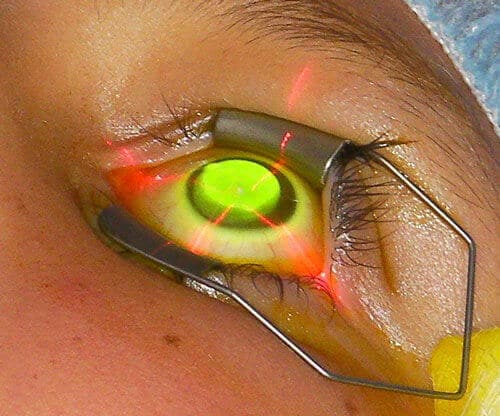
Laser-guided cross-linking is a more customized approach to corneal cross-linking that uses detailed measurements of the patient’s cornea to guide where treatment is applied. Advanced corneal topography and tomography create a detailed map of the cornea, allowing the treatment to be planned according to its individual shape and areas of irregularity.
Rather than treating the cornea with the same pattern throughout, laser-guided cross-linking allows UV energy to be delivered in a customized pattern, with greater treatment directed toward the areas where it is most needed. This is especially relevant in keratoconus because no two keratoconic corneas are exactly alike.
How Does Laser-Guided Cross-Linking Work?
Laser-guided cross-linking begins with advanced diagnostic imaging. Detailed measurements are taken to evaluate the cornea’s shape, curvature, thickness, and areas of greatest irregularity.
From there, the treatment can be planned in three basic steps:
- The cornea is mapped in detail. Advanced imaging provides information about the location and severity of the corneal irregularity.
- The most affected areas are identified. The treatment pattern is customized based on the patient’s individual corneal shape.
- UV treatment is applied in a customized pattern. Rather than distributing the treatment effect uniformly, energy can be concentrated over the areas where greater strengthening and flattening may be beneficial.
The objective remains the same as traditional cross-linking: strengthening the cornea and reducing the risk of further progression. The difference is in how that treatment is distributed.
What Are the Benefits of a More Targeted Approach?
Greater Precision
Keratoconus can look very different from one patient to another. A customized treatment allows the cross-linking pattern to reflect those differences. Instead of using a one-size-fits-all approach, laser-guided cross-linking is planned around the actual shape and irregularity of the individual cornea.
Potential for Improved Corneal Regularity
The first priority of cross-linking remains stabilization. However, in certain cases, targeted cross-linking may also produce more localized flattening of the steeper portions of the cornea. This may result in a more regular corneal shape and, for some patients, possible improvement in vision with glasses or contact lenses.
These changes are not guaranteed, and laser-guided cross-linking should not be considered a standalone vision correction procedure. However, improving corneal shape can be an important secondary benefit as part of a larger keratoconus treatment strategy.
More Targeted Use of Treatment Energy
Because treatment is customized to the cornea, the cross-linking effect can be concentrated where it is most needed rather than treating every area identically. For an inherently irregular condition such as keratoconus, that ability to customize treatment can be valuable.
How Laser-Guided Cross-Linking Fits Into a Complete Keratoconus Treatment Plan
At the Cornea & Laser Eye Institute, we manage keratoconus treatment with our KC 1, 2, 3 approach, which means your individual needs are matched to a customized treatment plan to:
- Stabilize the cornea →
- Improve corneal shape →
- Optimize vision
Cross-linking addresses the critical first step by strengthening the cornea and helping stop progression. But stabilization may not be the end of treatment. Depending on the individual patient, laser-guided cross-linking may be used on its own or incorporated into a broader treatment plan. Other procedures, such as CTAK or topography-guided PRK, may be considered to further improve corneal shape and visual function. The appropriate combination and sequence of treatments depends on the patient’s age, corneal shape and thickness, degree of progression, vision, and other individual factors.
Who Is a Candidate for Laser-Guided Cross-Linking?
Laser-guided cross-linking may be considered for patients with progressive keratoconus when their corneal pattern makes a customized treatment approach appropriate. However, choosing a cross-linking procedure is not simply a matter of selecting the newest technology.
Keratoconus is defined by irregularity, which means each cornea needs to be evaluated individually. Detailed imaging and a comprehensive examination help determine whether targeted cross-linking, traditional epi-off cross-linking, epi-on cross-linking, or another approach is most appropriate. At CLEI, we offer multiple approaches to cross-linking so treatment can be selected for the individual patient rather than requiring every patient to fit the same protocol.
What Results Can You Expect?
The primary objective of any keratoconus cross-linking treatment is to slow or stop progression. With laser-guided cross-linking, there may also be an opportunity for targeted flattening and improvement in corneal regularity. For some patients, this can contribute to better vision with glasses or contact lenses.
However, cross-linking should not be confused with procedures designed primarily to correct refractive error. Changes in corneal shape and vision vary from patient to patient, and improvement can take time. In some cases, laser-guided cross-linking is one step in a broader plan to stabilize the eye first and then pursue additional improvements in corneal shape and vision.
Why Experience and Technology Matter
Advanced technology makes customized cross-linking possible, but technology is only one part of the equation. Accurate diagnosis, interpretation of corneal imaging, treatment planning, and understanding how cross-linking fits alongside other keratoconus procedures all require experience with corneal disease.
CLEI specializes in keratoconus and offers a range of treatment options rather than relying on a single procedure for every patient. This allows our doctors to develop a plan based on the individual cornea and the patient’s long-term visual needs.
A More Personalized Way to Stabilize Keratoconus
Cross-linking has changed how doctors manage progressive keratoconus by giving us the ability to strengthen the cornea before the disease advances further. Laser-guided cross-linking takes personalization a step further.
By using detailed corneal imaging to guide treatment, the procedure can concentrate its effect over the areas of greatest irregularity. For appropriately selected patients, this may provide more targeted flattening while still accomplishing the essential goal of stabilizing the cornea. The important question is not simply whether laser-guided cross-linking is “better.” It is which form of cross-linking is best suited to your cornea. A comprehensive keratoconus evaluation can help answer that question and determine how cross-linking fits into your overall treatment plan.
Frequently Asked Questions
Is laser-guided cross-linking better than traditional cross-linking?
Not necessarily for every patient. In certain cases, laser-guided cross-linking may offer more targeted flattening of the steeper or more irregular portions of the cornea. This can potentially create a more regular corneal shape and may improve vision with glasses or contact lenses. The best approach depends on the individual cornea.
Can laser-guided cross-linking improve vision?
Potentially. The primary goal is still to stabilize keratoconus and prevent further progression. However, because treatment can be concentrated over specific areas of irregularity, some patients may experience improvements in corneal shape and, consequently, their glasses- or contact-lens-corrected vision.
How do I know which type of cross-linking I need?
A comprehensive evaluation is necessary. Keratoconus creates different patterns of irregularity in every cornea, so there is no single cross-linking approach that is appropriate for everyone. CLEI offers laser-guided cross-linking as well as more traditional epi-off and epi-on cross-linking approaches. Detailed imaging and examination allow your doctor to recommend the treatment best suited to your individual cornea rather than applying the same protocol to every patient.
Is recovery different from standard cross-linking?
Recovery is generally similar, although the exact experience depends on the cross-linking technique used and the individual patient. Vision may fluctuate during healing, and it can take several months for changes in corneal shape and vision to fully settle.




